 Reglyph
Scan and translate Spanish to English
without flattening the page into plain text
A scanned page is just a picture. Ordinary translators either refuse it or hand back a wall of loose text with the layout gone.
Reglyph reads the Spanish, erases it from the page image, and sets the English back into the same space. Stamps, seals and signature lines stay exactly where they were — they were never text to begin with.
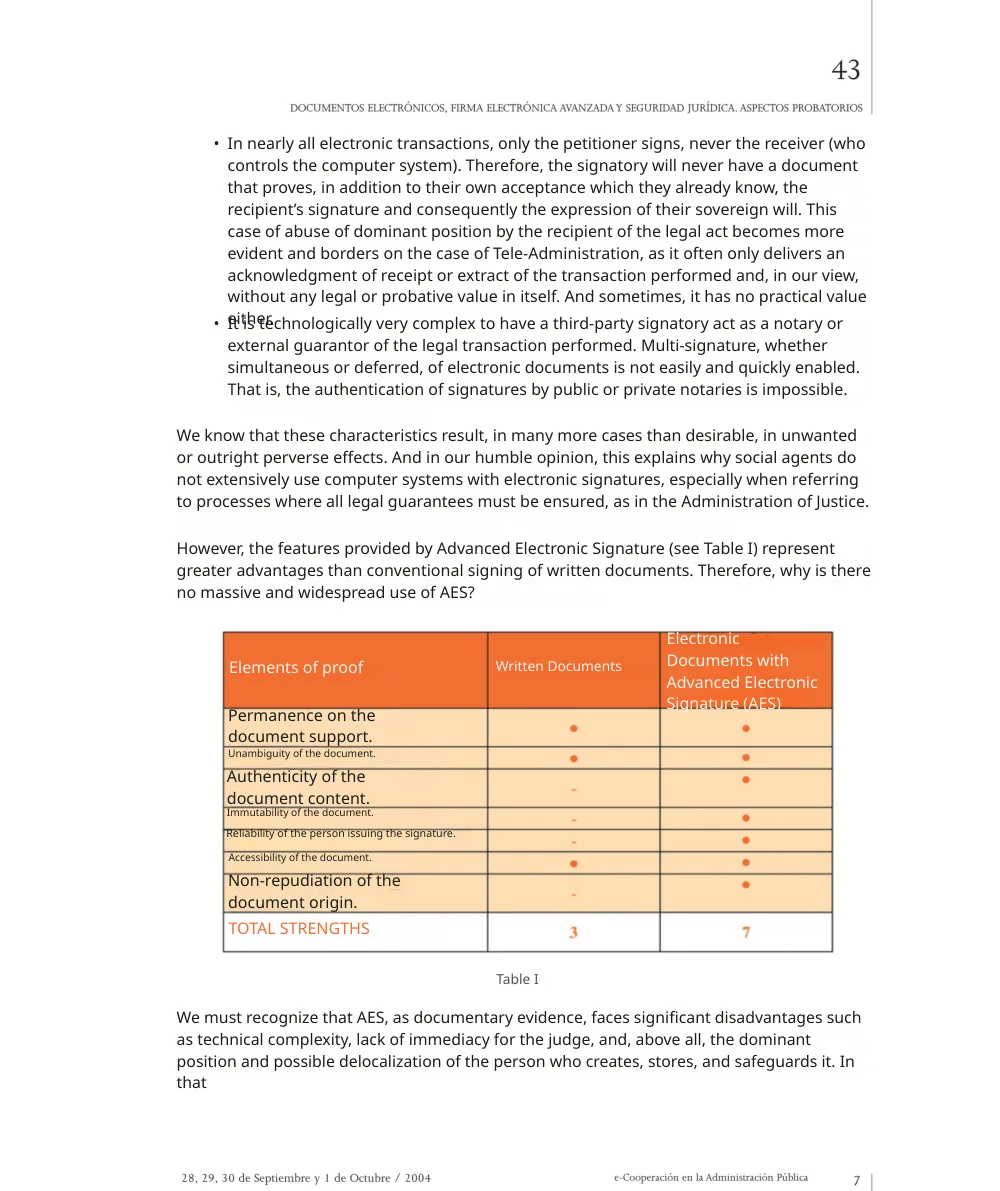
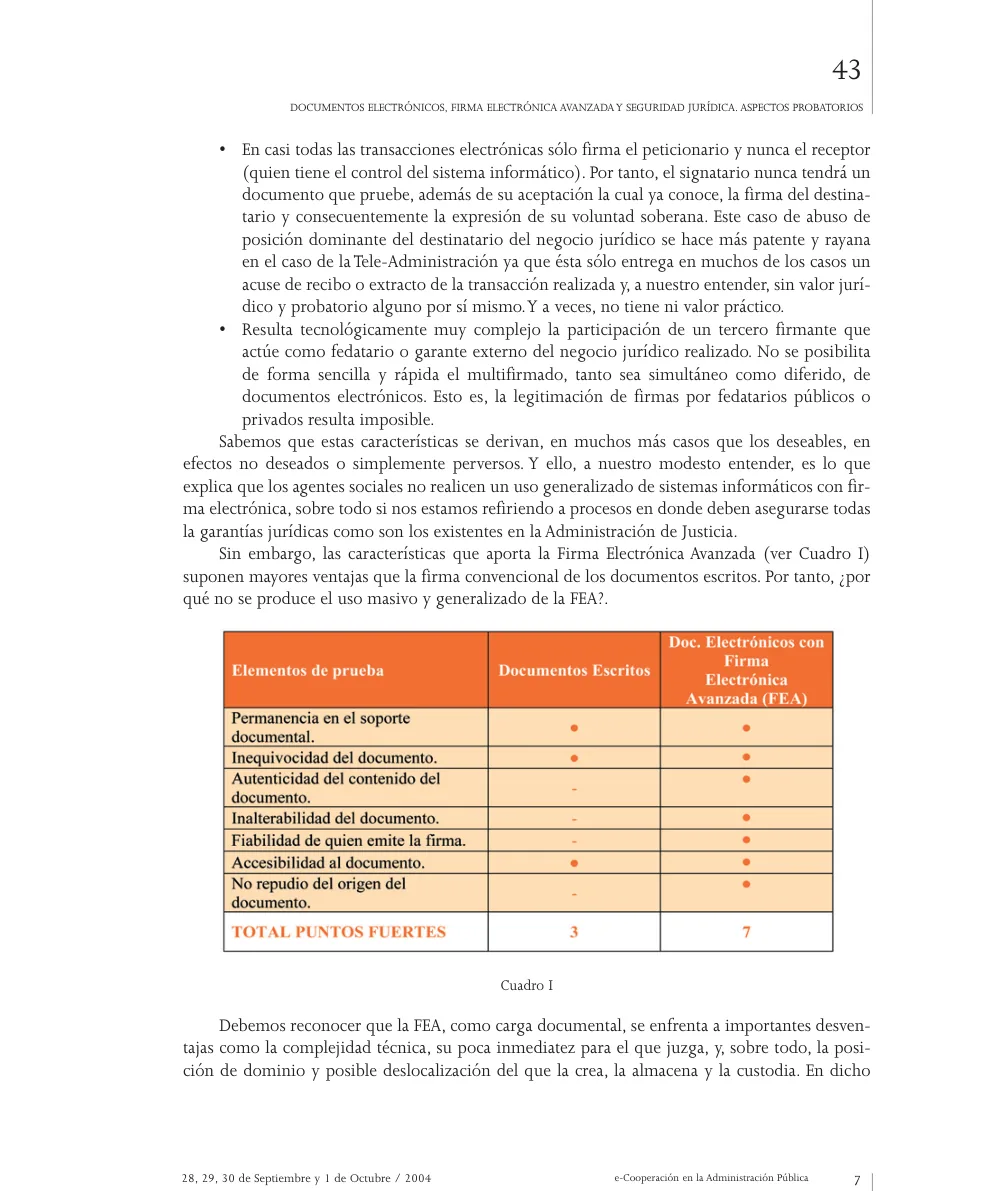
A real scanned Spanish page, before and after
This is page 43 of a Spanish conference paper on electronic signatures and legal certainty. Nothing here is a mock-up — drag the handle and compare it line by line.
The argument on this page rests entirely on Table I, and the content of that table is not words — it is a grid of dots and dashes showing which properties each kind of document has. Pull the text out of this page and reflow it, which is what a normal translator does, and you get a table of empty rows with a heading on top. The two-tone orange banding, the marks and the 3-against-7 totals all have to stay where they are or the page stops meaning anything.
- the orange header band and the peach row shading of Table I
- every dot and dash in the grid — on this page the marks are the content
- the TOTAL STRENGTHS row, 3 against 7
- the page number and the rule down the outer margin
One word ran over: “either”, at the end of the first bullet, sits on top of the line below it — English needed one more line than the Spanish had left. In the table, rows whose English label grew are set smaller than the rest; compare “Unambiguity of the document” with “Permanence on the document support” directly above it.
Scanning Spanish documents — frequently asked
Already have a digital Spanish PDF rather than a scan? Spanish → English document translation
Can I scan a Spanish document with my phone and translate it?
Yes, as long as you save the scan as a PDF. Both phones have a document scanner built in that outputs one — on iPhone it is the Files app under Scan Documents, on Android it is the Google Drive app under Scan. Reglyph reads image-only PDFs directly, so there is no need to run OCR yourself first.
Will the stamps and signatures survive?
Yes. Stamps, seals, signatures and handwriting are part of the page image, not part of the text, so they are left where they are. Only the printed Spanish is removed and replaced with English.
My scan is a bit crooked — does that matter?
A slight skew is fine. What hurts is glare, a shadow falling across the page, and photographing at an angle so the lines converge. The document scanners built into iPhone and Android correct perspective automatically, which is why they beat a plain camera photo.
Choose your plan
Simple, scan-friendly pricing. Pages are pages — no multiplier for scanned files.
Sold in packs of 10 at $5 — 2 packs, you get 20 pages.
- $0.50 / page, in packs of 10
- Pages never expire
- Up to 100 MB per file
- $0.13 / page
- 120 pages every month
- Up to 100 MB per file
- Pages reset each month
- $0.06 / page
- 700 pages every month
- Unused pages roll over (up to 2,100)
- Big files up to 300 MB
Guides on translating scanned documents
Gemini's long context makes it the most patient of the chat assistants with a big PDF. It still hands you back a conversation, not a document.
Read guideThe word has stopped meaning anything on a pricing page. What matters is which of three very different things is doing the work — and what comes out the other end.
Read guideMost people asking for a notarized translation don't need one. The ones who do usually need it for a specific office abroad — and the notary never checks the translation.
Read guide